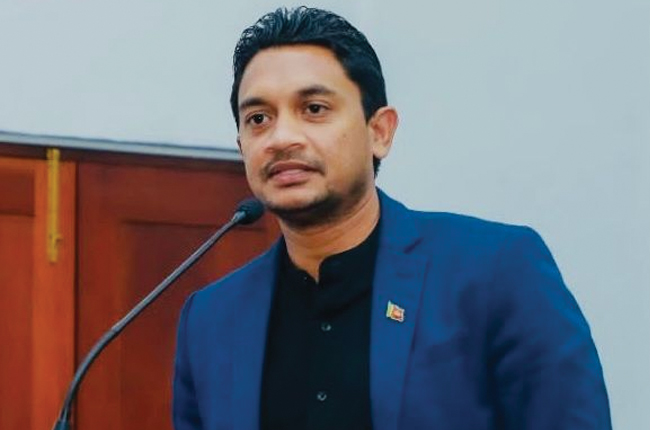
The Sri Lankan economy has become predictable and stable, enhancing investment opportunities with the Government undertaking institutional reforms through digitization, creating a single window for trade and investments Deputy Minister of Industries and Entrepreneurship Development Chathuranga Abeysinghe told the Global Innovation & Leadership Summit held in Colombo on May 2.
Large-scale infrastructure projects, including highways and ports are developing amid a disciplined fiscal management system with support from the IMF, he said.
“Sri Lankan economy is now predictable. So it has been predicted with the support of the IMF, with our debt repayment plans being planned for the next six years. So it’s a predictable economy. No better place than a predictable economy for investments to ensure that you have your risks mitigated, because we go on a structured programme for the next six years. And at the same time, not only all the economic indicators, you would have seen, on the International Labour Day, the May Day we call it, strong support across the nation for the current government, which has two-thirds power in the parliament with the executive president. So the stability is secured for you to come and invest,” Abeysinghe opined.
He said Sri Lanka lagged in reforms compared to India, South Korea, and Vietnam and was not able to use the technology as a strategic transformation tool failing to utilize technology and connect globally, while deep-rooted corruption contributed to its 2022 economic crisis. Post-uprising progress is underway, aiming for significant transformation, though challenges remain, particularly with structural corruption. So there is a compelling reason why someone would pick Sri Lanka at this point to bring in investment as structural corruption has ended, The Minister said corruption has historically hindered investments, requiring bribes for political access; however, this practice ended 15 months ago. Sri Lanka is implementing significant tariff reforms to connect with global trade agreements, especially with East Asia and India. New laws are being established to protect investments, introduce insolvency regulations, and foster public-private partnerships.
“We have already passed the new Investment Promotion Act. We have readjusted and made it clear how to invest in our port city. The Investment in Port City Act has already been placed. And in terms of investment protection, we will be passing another bill this year that will ensure the foreign investments will be protected in a far greater way than they should. And in terms of insolvencies, as we didn’t have an Insolvency Act in this country, this will be tabled in Parliament next week and will be passed within the next two months,” Abeysinghe said.
The minister said the Western Province Governor highlighted the deep historical ties between India and Sri Lanka, emphasizing India’s support during Sri Lanka’s troubles. With over 100 Indian investments in Sri Lanka, the goal is to increase this to 1,000, utilizing Sri Lanka as a platform to access global markets. “Sri Lanka has a platform to reach the East, Middle East, and the West because with the EU, we have a GSP-plus trade agreement. We have a large trade partnership with the US. So Indian businesses can use Sri Lanka as a manufacturing base and reach the rest of the world through us as well,” he said.
Abeysinghe also emphasized the fact that support is needed to connect local industries to global value chains through brownfield investments and startups, overcoming land and resource limits. Despite being late in industrialization, a resilient ecosystem is evolving. Sri Lanka offers investment opportunities to transform its economy, especially in agriculture, he said.
Source : Daily News