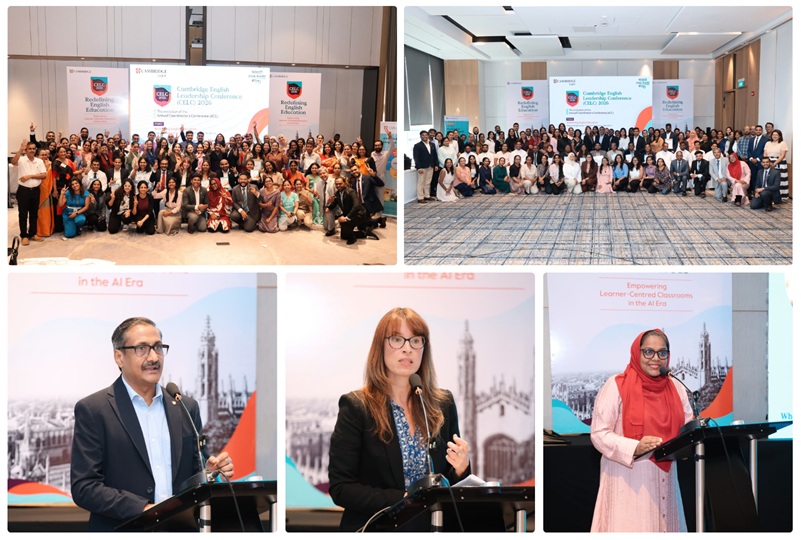
Cambridge University Press & Assessment hosted the Cambridge English Leadership Conference (CELC) 2026 in Colombo, bringing together principals, school leaders and English educators to discuss how schools can prepare learners for success in an increasingly AI-enabled world. The conference explored how learner-centred classrooms, effective assessment, data-driven feedback, and strong foundations in communication can help students thrive academically and professionally.
The discussions come at a time when English proficiency is increasingly recognised as a critical employability skill. Findings from a Cambridge survey of nearly 1,900 students across South Asia found that almost 100% consider English important for securing a good job, while 30% identified English skills and confidence as a key barrier to employment. More than half (57%) reported that they do not feel fully prepared for placements. As the same students identify core skill gaps in comprehension and confidence as barriers, over 80% of students focus on three add-ons: technical/industry certifications, internships or real-world projects, and English language certification.
The findings also reinforce a critical reality that communication skills employers value, are developed over the course of a learner’s school education. Strong foundations in listening, speaking, reading and writing established during the formative years play a significant role in shaping future academic success, confidence and employability.
For Sri Lankan learners, English is more than a language of instruction; it is a language of opportunity, opening doors to higher education, meaningful employment and global citizenship Thus, schools are placing greater emphasis on communication and critical-thinking skills from the foundational years onward.
While AI technologies are getting embedded in education and work, participants of the survey highlighted that students need more than access to information. Strong capabilities in Listening, Speaking, Reading and Writing (LSRW) remain essential to help learners interpret information, think critically, ask meaningful questions, collaborate effectively and communicate with confidence.
“As AI becomes part of everyday learning, the ability to communicate, analyse and think critically becomes even more important. These are skills that are built progressively throughout a child’s school journey and are rooted in strong foundations in listening, speaking, reading, and writing. Our research shows that students recognise the importance of English for future employment, yet many continue to face challenges with confidence and communication. This reinforces the need for schools to focus not only on teaching English as a subject, but on developing measurable language proficiency that supports academic success, employability and lifelong learning,” said Arun Rajamani, Managing Director, South Asia, Cambridge University Press & Assessment.
“Education opens minds. English opens doors. Together, they create futures without boundaries. Technical skills may secure an interview, but communication skills often determine career progression. In Sri Lanka’s increasingly global economy, English remains one of the most valuable employability skills. We work together with Schools, Higher Education Institutes and Preparation Centres across Sri Lanka to take life-long valid Cambridge English Certifications to all parts of Sri Lanka” stated Zahara Ansary, Country Head – Cambridge University Press & Assessment for Sri Lanka & The Maldives.
Key conference sessions led by Cambridge expert Helen Kenyon explored strengthening learner-centred classrooms through better insight, instruction and feedback; using digital tools to support inclusive and autonomous learning; interpreting assessment results to provide meaningful learner support; engaging parents through effective communication; and understanding whether AI can act as a co-teacher in modern classrooms.
Participants also discussed the growing importance of benchmarking language proficiency against internationally recognised standards. Educators explored how schools can move beyond subjective measures and use robust assessment frameworks to understand learner progress across listening, speaking, reading and writing. Cambridge English Qualifications, aligned to the Common European Framework of Reference (CEFR), provide schools with internationally recognised benchmarks to track learner development and identify areas requiring targeted support.
At the conference, best performing Cambridge English Preparation Centres from across the island were recognized along with 12 top awards given for excellence, along with the Top Distributors for Cambridge Resources also being felicitated.
Special Award Winners –
- Boswell College International, Kalutara
- Cambridge College of British English
- Cambridge College of Linguistics & Education (Pvt) Ltd, Colombo,
- English House (Local & Foreign Exam Centre), Minuwangoda
- ESOL College International
- Gateway Language Centre, Colombo
- Institute of British Examinations, Negombo
- St. John Paul II Institute of Higher Education, Wennappuwa,
- St. Sebastian’s English Language Academy, Moratuwa
- UNEX College of Higher Education Kurunegala
- Vinex College of English, Kurunegala
Notes to Editors: Cambridge English Qualifications assess Listening, Speaking, Reading and Writing skills and are aligned to the CEFR. Interviews with Cambridge spokespeople are available on request.
About Cambridge
Cambridge University Press & Assessment unlocks the potential of millions of people worldwide. It provides world-leading academic research, learning and assessment globally, backed by the first-class teaching and research departments of the University of Cambridge. For more information: https://www.cambridge.org/